
Exploring the universe through Artificial Intelligence
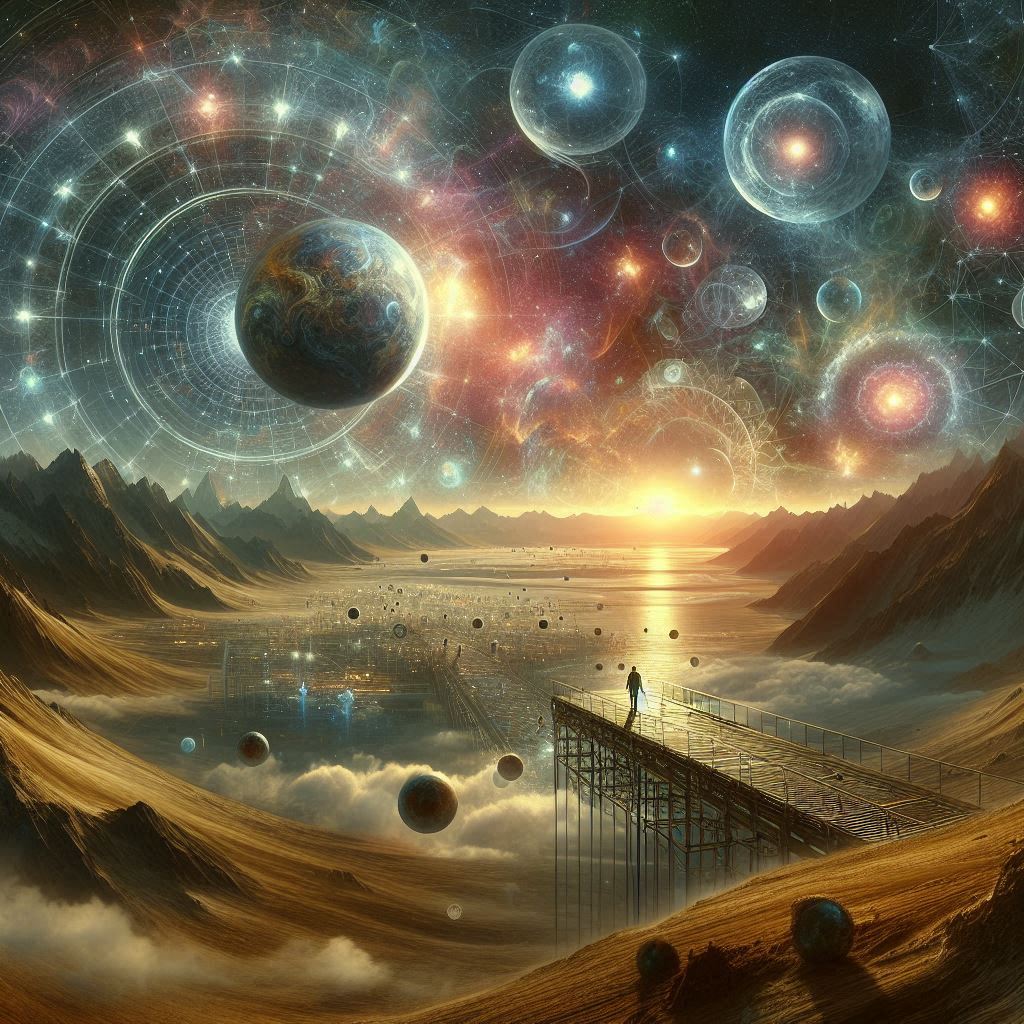
Historical: intelligent automata (Talos), artificial beings (Galatea and Pandora), Ars Magna, a universal calculus of reasoning (the alphabet of human thought), the concept of "utility", the foundations of Bayes' theorem, artificial neural networks (the perceptron), Game Theory, the ratio Intelligent Machinery, Hebbian learning, Turing test, First functional AI programs; (inter)national conferences, behavior-based robotics, using machine learning algorithms to identify exoplanets, DARPA Grand Challenge, Artificial Compassionate Intelligence, use of AI in Martian exploration, deep learning network, spatial mapping, Asilomar Conference on Beneficial AI, language models (T‑NLG, GPT‑3), First Global Summit on AI Safety, Google releases Gemini 1.5, OpenAI publicly announces Sora, StabilityAI Announces Stable Diffusion 3, AI is constantly revealing new discoveries to us
Notable achievements: Discovery of exoplanets, Mapping of space, Autonomous planetary missions, Search for extraterrestrial intelligence, Simulation and modeling of the universe, Analysis of astronomical data, Finding space debris, Human-robot interaction, Extracting information from astronomical images, Identification of cosmic structures, Error correction of space instruments, Planning of space missions, Exploration of deep space, Prevention and anticipation of space disasters, Optimizing spacecraft performance and efficiency, Detecting cosmic signals, Analyzing planetary composition and structure, Assisting in lunar exploration; Machine Learning and Neural Networks, Natural and Conversational Language Processing, Artificial Vision and Image Processing, Robotics and Human-Machine Interaction, Data Processing and Data Mining, Security and Threat Detection, Health Care, Process Automation, Medical Expert Systems, Artificial Intelligence in Manufacturing, Generative Adversarial Models, Quantum Learning, Predicting User Behavior, Knowledge Management Systems, Software Testing Automation, Multi-Objective Reinforcement Learning, Cognitive Modeling, Non-Guaranteed Cost Learning, Automatic Situation Assessment, Response and Action Prediction, Human Behavior Reverse Engineering, Knowledge Management Systems, Genetic Algorithm Learning
Exemplary stories: Mars Rover Curiosity, Deep Space Network, SETI Project, Kepler Space Telescope, SkyNet Project, Blue Brain Project, Film The Martian, Breakthrough Starshot Project, Voyager Program; Sample Books, Sample Movies, Sample Games and Software
Portrait galleryYann LeCun, Crizhhevsky, Ethan Rublee
Exploration through Imaginary/Speculative Fiction: Literary works, Cinematographic works, Computer games
Unclear hypotheses/conspiracies/mysteries: Control of information, Supervision of outer space, Autonomy of space systems, Communication with extraterrestrial civilizations
Perspective: interpretation of astronomical data, complex cosmic phenomena and the possibilities of life in the entire universe, better anticipation of risks and increased efficiency in space research, improved performance of space robots, associated ethical challenges and responsibilities
Author
- Select language
 Română/carti/dincolo-de-orizont/explorarea-universului-prin-inteligenta-artificiala/
 Deutsch/de/carti/dincolo-de-orizont/explorarea-universului-prin-inteligenta-artificiala/
 English/en/carti/dincolo-de-orizont/explorarea-universului-prin-inteligenta-artificiala/
 Español/es/carti/dincolo-de-orizont/explorarea-universului-prin-inteligenta-artificiala/
 Esperanto/eo/carti/dincolo-de-orizont/explorarea-universului-prin-inteligenta-artificiala/
 Français/fr/carti/dincolo-de-orizont/explorarea-universului-prin-inteligenta-artificiala/
 Italiano/it/carti/dincolo-de-orizont/explorarea-universului-prin-inteligenta-artificiala/
 Latīna/la/carti/dincolo-de-orizont/explorarea-universului-prin-inteligenta-artificiala/
 Português/pt/carti/dincolo-de-orizont/explorarea-universului-prin-inteligenta-artificiala/
 中文(简体)/zh/carti/dincolo-de-orizont/explorarea-universului-prin-inteligenta-artificiala/
 日本語/ja/carti/dincolo-de-orizont/explorarea-universului-prin-inteligenta-artificiala/
 한국어/ko/carti/dincolo-de-orizont/explorarea-universului-prin-inteligenta-artificiala/
Edit Translation