

Quantum physics and a constructive mindset
Quantum physics and a constructive mindset
Daria Dragotoiu
Mindset is a person's belief system about the nature of their abilities and capabilities, such as intelligence or personality. The theory of mindsets or the implicit theory of intelligence is based on self-confidence as the main pillar, branching into growth mindset, when confidence in one's own powers and abilities is increased, and fixed mindset, when the individual believes that his abilities are set in stone. usually being heard saying the word "so God left me".[1] The first one embraces the continuous learning and development of the individual, possessors of the other type of mentality rather seeking validation for their actions and achievements, which makes them vulnerable to the inevitable mistakes or obstacles that may appear along their way to a goal.[2]
In a seemingly different order of ideas, quantum physics reaches an overwhelming conclusion for the untrained mind of man to consider infinity as the fundamental truth of physical existence. However, nature challenges us to adapt to the situation, accepting as reality the statement that an electron has no definite position, it is not somewhere, until we measure it. This conclusion was drawn from the Thomas Young experiment of the two slits[3], which can be imagined as follows: An electron beam was sent to a screen, with a screen between two very narrow (nanometer-sized) slits (openings), to cause diffraction. Below is a figure suggesting how the light wave behaves when it encounters the slits.
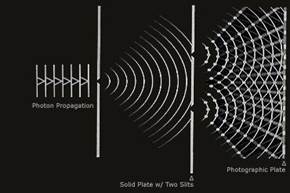
When we sent the electrons to the screen, they showed an interference pattern, as if they were going through both slits at the same time and interfering with themselves to form an unexpected interference pattern.[4]
Strange! We would have expected the electrons to behave like ordinary balls, that is, to get two stripes on the screen representing the electrons that managed to pass through that slit.
What's even stranger is that when we used a detector to find out which slit the particle went through, we got a normal, two-stripe pattern on the screen, as if the electrons were ashamed of their wave behavior and chose to conform to our initial expectations. So by trying to observe the behavior of the particle you change its state!
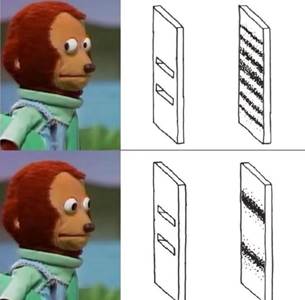
This topic of discussion ignited the famous dispute between Einstein and Bohr at the Solvay conferences, held to provide a forum for the brightest minds in science.[5] Einstein dared to say that we live in a deterministic universe, where we can predict any event if we have good enough equations to describe it, while Bohr was convinced that particles live in a space with infinite potential to be in one place or another, and only when we interact with the particle does it choose a state to be in. This friendly contradiction took place during the years 1927-1930, being supported by both camps with scientific arguments as rigorous as they were intuitive.
I have come to the conclusion that reality is defined by observation. If we can apply this to particles, could we apply it to our own mentality? Just think! There are an infinity (or at least a very large number) of beliefs, opinions, and ways to interpret reality. Observing and measuring the particle that causes it to collapse into one state is action and word in the case of an individual. The object to be observed in the latter case is one's own condition, one's own convictions, limitations and beliefs that restrict the subject's infinite potential of existence to a single possibility composed and perceived through their filter. My favorite part is when we learn that we can choose how we shape our corner of reality. Do we choose to charge ourselves with sunlight in the morning and wear it in the form of a smile on our faces for the rest of the day even if it rains at lunch, or do we complain to our colleagues for the rest of the day that it's ugly and cold outside? Thus, mindset ends up being a very important topic, not being limited to achieving goals and self-improvement, but rather being the key element that shapes our everyday lives!
A disciplined mental exercise is the basis of an easy life. Subjectively and metaphorically, I apply quantum physics in my daily life: I use an inner compass calibrated by sincerity that uses my own feelings and emotions as compass needles, I can easily identify when I am creating a reality that does not serve me. The compass indicates to me at any time that I am willing to notice that there are limitations that cause negative emotions and feelings of tension and heaviness in my body. Once I receive the signal, I make a quantum leap: first I identify the emotions, sensations and thoughts to then realize why I want to get rid of them (I realize their negative influence on my well-being). I get rid of them by canceling them and jump into another reality where they don't exist or aren't valid. This way, I manage every day to disabuse my brain of falling prey to habits and patterns that bring drama, trauma and pleasure into my present. The book Atomic Habits helped me understand that our brains are designed to keep us alive. [6]It is an extraordinary thing, for to be alive is a blessing. However, those of us who have the luxury of philosophizing and reading about mindsets, infinity, and quantum physics are most likely not in a strictly survival situation. Thus, the brain and what it knows how to do may not be enough in the context where we want more from life than the comfort of minimal survival.
The bottom line is that we can consciously train our brains to seek out and choose the best reality from the infinity of available realities with the help of our inner compass. Thus, instead of using a simple detector to observe the particle in which state it chooses to collapse at that moment, we build a supercomputer that influences the particle to collapse into the most favorable state it can be in.
Bibliography
Bernecker, Katharina, and Veronika Job. “Mindset theory.” Social psychology in action: Evidence-based interventions from theory to practice (2019): 179-191.
"Bohr–Einstein debates", in https://en.wikipedia.org/wiki/Bohr%E2%80%93Einstein_debates, 7/04/2025.
Clear, James, Atomic Habits, Lifestyle Publishing, f.a.
"Thomas Young's double-slit experiment: a gateway to the quantum world", in https://www.scientia.ro/fizica/50-mecanica-cuantica/9054-experimentul-cu-doua-fante-al-lui-thomas-young-o-poarta-catre-lumea-cuantica.html, 7/04/2025.
,,A book reviewthe mindset,de Carol S. Dweck,made byIuliana Stanthrough the lens of the circumplex”, in https://culturaorganizationala.ro/cultura-la-zi/constructiv/mindset-cum-ne-educam-mentalitatea/ , April 8/ 2024.
[1] ,,A book reviewthe mindset,de Carol S. Dweck,made byIuliana Stanthrough the lens of the circumplex", in https://culturaorganizationala.ro/cultura-la-zi/constructiv/mindset-cum-ne-educam-mentalitatea/ , April 8/ 2024.
[2] Bernecker, Katharina, and Veronika Job. “Mindset theory.”Social psychology in action: Evidence-based interventions from theory to practice(2019): 179-191.
[3] See Thomas Young's Two-Slit Experiment: A Gateway to the Quantum World, in https://www.scientia.ro/fizica/50-mecanica-cuantica/9054-experimentul-cu-doua-fante-al-lui-thomas-young-o-poarta-catre-lumea-cuantica.html, 7/04/2025.
[4] Ibidem.
[5] To consult "Bohr–Einstein debates", in https://en.wikipedia.org/wiki/Bohr%E2%80%93Einstein_debates, 7/04/2025.
[6] James Clear, Atomic Habits, Lifestyle Publishing, f.a.
Author

- Select language
 Română/carti/infinit/fizica-cuantica-si-un-mindset-constructiv/
 Deutsch/de/carti/infinit/fizica-cuantica-si-un-mindset-constructiv/
 English/en/carti/infinit/fizica-cuantica-si-un-mindset-constructiv/
 Español/es/carti/infinit/fizica-cuantica-si-un-mindset-constructiv/
 Esperanto/eo/carti/infinit/fizica-cuantica-si-un-mindset-constructiv/
 Français/fr/carti/infinit/fizica-cuantica-si-un-mindset-constructiv/
 Italiano/it/carti/infinit/fizica-cuantica-si-un-mindset-constructiv/
 Latīna/la/carti/infinit/fizica-cuantica-si-un-mindset-constructiv/
 Português/pt/carti/infinit/fizica-cuantica-si-un-mindset-constructiv/
 中文(简体)/zh/carti/infinit/fizica-cuantica-si-un-mindset-constructiv/
 日本語/ja/carti/infinit/fizica-cuantica-si-un-mindset-constructiv/
 한국어/ko/carti/infinit/fizica-cuantica-si-un-mindset-constructiv/
Edit Translation